Notitie
Voor toegang tot deze pagina is autorisatie vereist. U kunt proberen u aan te melden of de directory te wijzigen.
Voor toegang tot deze pagina is autorisatie vereist. U kunt proberen de mappen te wijzigen.
MCP apps are interactive UI widgets that run inside Microsoft 365 Copilot, powered by Model Context Protocol (MCP) servers. They allow declarative agents to go beyond text responses and deliver rich, actionable experiences directly in the Copilot chat. You can add MCP apps to your declarative agents by adding an MCP server-based action to your agent and extending the MCP tools used by the agent to include UI. Microsoft 365 Copilot supports UI widgets created using the following methods.
- MCP Apps - an extension to MCP that enables MCP servers to deliver interactive user interfaces to hosts.
- OpenAI Apps SDK - tools to build ChatGPT apps based on the MCP Apps standard with extra ChatGPT functionality.
For example MCP server plugins, see MCP based interactive UI samples for Microsoft 365 Copilot on GitHub.
For details on which MCP Apps or OpenAI Apps SDK capabilities are supported, see Supported MCP Apps capabilities in Copilot.


Prerequisites for MCP apps
- Requirements specified in Requirements for Copilot extensibility options
- A remote MCP server that provides UI widgets or that you can modify to implement UI widgets
- A tool to view MCP server responses, such as MCP Inspector
- Visual Studio Code
- Microsoft 365 Agents Toolkit (version 6.6.1 or later)
MCP server requirements for MCP apps
- Authentication - OAuth 2.1 and Microsoft Entra single sign-on (SSO) are supported. Anonymous authentication is supported for development purposes. For details on authentication, see Configure authentication for API plugins in agents.
- Allowed URLs - the following URLs should be allowed by both your MCP server and your identity provider.
- Widget host URL for CORS - Copilot renders widget UI under an MCP server-specific host with the following URL:
{hashed-mcp-domain}.widget-renderer.usercontent.microsoft.com, where{hashed-mcp-domain}is the SHA-256 hash of your MCP server's domain. You can use the Widget Host URL Generator to generate the host URL based on your MCP server URL. - OAuth 2.1 redirect URIs:
https://teams.microsoft.com/api/platform/v1.0/oAuthRedirectfor Copilothttps://vscode.dev/redirectfor Visual Studio Code to fetch tools using the Agents Toolkit
- Microsoft Entra SSO redirect URIs:
https://teams.microsoft.com/api/platform/v1.0/oAuthConsentRedirectfor Copilot- Visual Studio Code doesn't currently support SSO for fetching tools
- Widget host URL for CORS - Copilot renders widget UI under an MCP server-specific host with the following URL:
- UI widgets - UI widgets must be implemented according to the MCP Apps or OpenAI Apps SDK requirements.
Best practices for MCP apps in Copilot
User experience design
For details on UX design best practices, see User experience guidelines for MCP apps in declarative agents for Microsoft 365 Copilot.
Verify API availability
Not all window.openai.* APIs are available on every platform or host. APIs that are unsupported are undefined. Always check API availability and provide a fallback if the API is unavailable.
Examples
This simple pattern avoids runtime errors by checking before calling the API.
if (window.openai.callTool) {
  const result = await window.openai.callTool({ name: 'myTool', params: {} });
} else {
  // Handle unsupported case — show fallback UI, skip the feature, etc.
}
In this example, a button to enter fullscreen mode is rendered only if the host supports the requestDisplayMode API.
function FullScreenButton() {
  // Don't render the button if the host doesn't support it
  if (!window.openai.requestDisplayMode) {
    return null;
  }

  return (
    <button onClick={() => window.openai.requestDisplayMode({ mode: 'fullscreen' })}>
      Enter Fullscreen
    </button>
  );
}
Alternatively, your widget can check availability of all APIs that it uses at startup and enable/disable features accordingly.
interface PlatformCapabilities {
  canCallTools: boolean;
  canChangeDisplayMode: boolean;
  canSendMessages: boolean;
}

function detectCapabilities(): PlatformCapabilities {
  return {
    canCallTools: !!window.openai.callTool,
    canChangeDisplayMode: !!window.openai.requestDisplayMode,
    canSendMessages: !!window.openai.sendMessage,
  };
}

// Use at widget startup
const capabilities = detectCapabilities();

if (!capabilities.canCallTools) {
  // Show a reduced-functionality experience
}
Create a declarative agent
Open Visual Studio Code and select the Microsoft 365 Agents Toolkit icon in the left-hand Activity Bar.
Select Create a New Agent/App in the Agents Toolkit task pane.
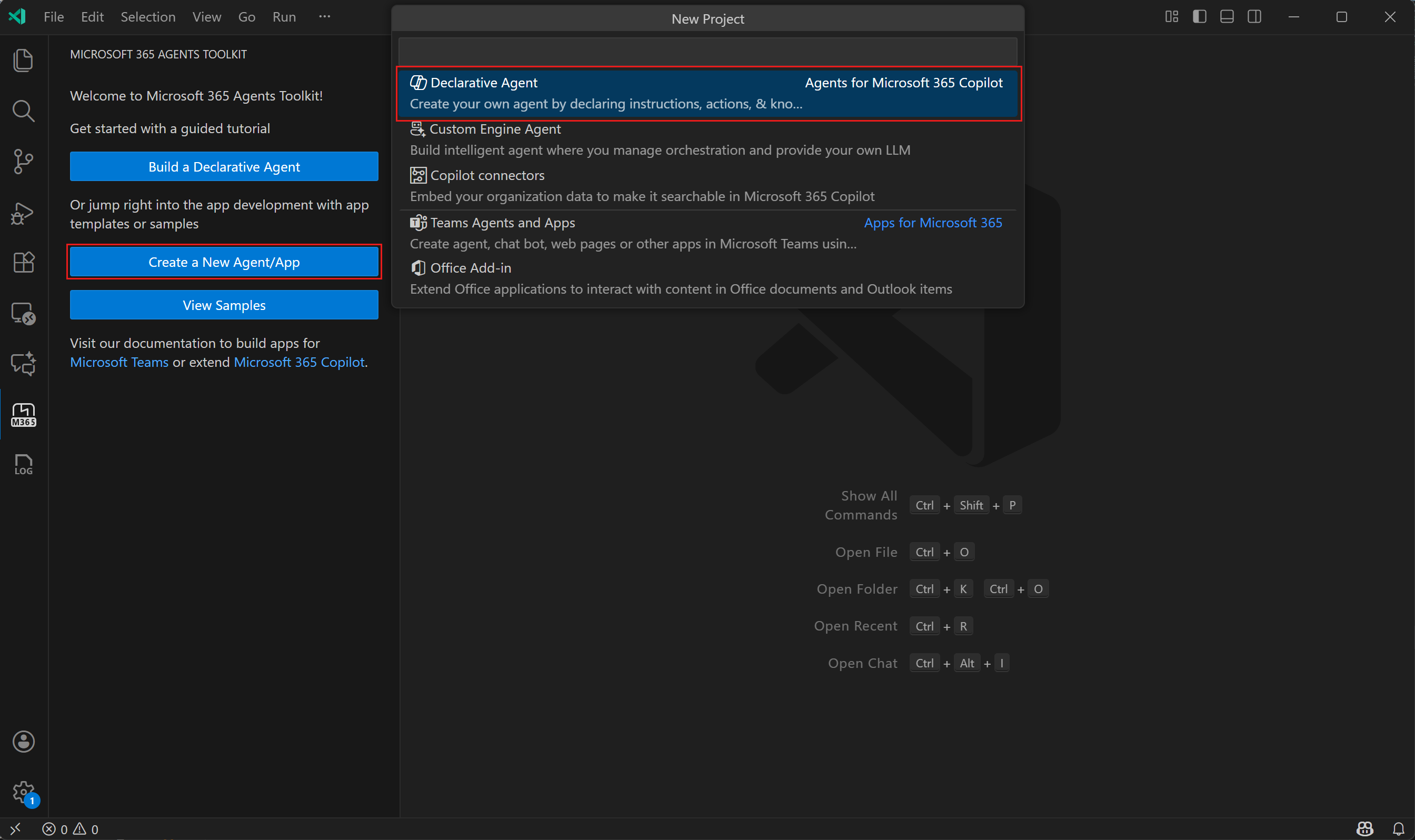
Select Declarative Agent.
Select Add an Action, then select Start with an MCP Server. If prompted, choose Remote MCP server.
Enter URL to your MCP server.
Choose a location for the agent project.
Enter a name for the agent.
When you complete these steps, Agents Toolkit generates the required files for the agent and opens a new Visual Studio Code window with the agent project loaded.
Update and sideload the agent
Open the .vscode/mcp.json file. Select the Start button in the file editor.
Select the ATK: Fetch action from MCP button in the file editor, then select ai-plugin.json.

Select the tools for the agent to use and select OK. Be sure to select at least one tool that has a UI widget.
Select the applicable authentication type.

Important
If your MCP server is in development and doesn't implement authentication, this step is skipped. You need to manually add authentication to your manifest once you add authentication to your server.
Select the Microsoft 365 Agents Toolkit icon in the left-hand Activity Bar.
In the Accounts pane, select Sign in to Microsoft 365. (If you're already signed in, continue to the next step).
Confirm that both Custom App Upload Enabled and Copilot Access Enabled display under your Microsoft 365 account. If they don't, check with your organization admin. See Requirements for Copilot extensibility options for details.
In the Lifecycle pane, select Provision.
If prompted, add your authentication details.
Wait for the toolkit to report that it finishes provisioning.
Test the agent
- Open your browser and go to https://m365.cloud.microsoft/chat.
- Select your agent in the left-hand sidebar. If you don't see your agent, select All agents.
- Ask the agent to do something that invokes your MCP server.
- Allow the agent to connect to the MCP server when prompted.
- The agent renders the UI widget.
If the widget doesn't appear or behave as expected, see Troubleshoot MCP apps in Microsoft 365 Copilot.
Supported MCP Apps capabilities in Copilot
Microsoft 365 Copilot supports the following capabilities.
Component bridge
| OpenAI Apps SDK | MCP Apps equivalent | Supported? |
|---|---|---|
window.openai.toolInput |
app.ontoolinput |
✅ |
window.openai.toolOutput |
app.ontoolresult |
✅ |
window.openai.toolResponseMetadata |
app.ontoolresult → params._meta |
✅ |
window.openai.widgetState |
— | ✅ |
window.openai.setWidgetState(state) |
Not directly available. Use alternative mechanisms including app.updateModelContext() |
✅ |
window.openai.callTool(name, args) |
app.callServerTool({ name, arguments }) |
✅ |
window.openai.sendFollowUpMessage({ prompt }) |
app.sendMessage({ ... }) |
✅ |
window.openai.uploadFile(file) |
— | ❌ |
window.openai.getFileDownloadUrl({ fileId }) |
— | ❌ |
window.openai.requestDisplayMode(...) |
app.requestDisplayMode({ mode }) |
✅ (full screen only) |
window.openai.requestModal(...) |
— | ❌ |
window.openai.notifyIntrinsicHeight(...) |
app.sendSizeChanged({ width, height }) |
✅ |
window.openai.openExternal({ href }) |
app.openLink({ url }) |
✅ |
window.openai.setOpenInAppUrl({ href }) |
— | ✅ |
window.openai.theme |
app.getHostContext()?.theme |
✅ |
window.openai.displayMode |
app.getHostContext()?.displayMode |
✅ |
window.openai.maxHeight |
app.getHostContext()?.viewport?.maxHeight |
✅ |
window.openai.safeArea |
app.getHostContext()?.safeAreaInsets |
✅ |
window.openai.view |
— | ✅ |
window.openai.userAgent |
app.getHostContext()?.userAgent |
✅ |
window.openai.locale |
app.getHostContext()?.locale |
✅ |
| — | app.ontoolinputpartial |
❌ |
| — | app.ontoolcancelled |
❌ |
| — | app.getHostContext()?.availableDisplayModes |
❌ |
| — | app.getHostContext()?.toolInfo |
❌ |
| — | app.onhostcontextchanged |
❌ |
| — | app.onteardown |
❌ |
| — | app.sendLog({ level, data }) |
❌ |
| — | app.getHostVersion() |
❌ |
| — | app.getHostCapabilities() |
✅ |
Tool descriptor _meta fields
| OpenAI Apps SDK | MCP Apps equivalent | Supported? |
|---|---|---|
_meta["openai/outputTemplate"] |
_meta.ui.resourceUri |
✅ |
_meta["openai/widgetAccessible"] |
_meta.ui.visibility (string[]) |
❌ |
_meta["openai/visibility"] |
_meta.ui.visibility (string[]) |
✅ |
_meta["openai/toolInvocation/invoking"] |
— | ❌ |
_meta["openai/toolInvocation/invoked"] |
— | ❌ |
_meta["openai/fileParams"] |
— | ❌ |
_meta["securitySchemes"] |
— | ❌ |
Tool descriptor annotations
| OpenAI Apps SDK | MCP Apps equivalent | Supported? |
|---|---|---|
readOnlyHint |
readOnlyHint |
✅ |
destructiveHint |
destructiveHint |
❌ |
openWorldHint |
openWorldHint |
❌ |
idempotentHint |
idempotentHint |
❌ |
Component resource _meta fields
| OpenAI Apps SDK | MCP Apps equivalent | Supported? |
|---|---|---|
_meta["openai/widgetDescription"] |
— | ❌ |
_meta["openai/widgetPrefersBorder"] |
_meta.ui.prefersBorder |
❌ |
_meta["openai/widgetCSP"] |
_meta.ui.csp |
✅ |
_meta["openai/widgetDomain"] |
_meta.ui.domain |
❌ |
| — | _meta.ui.permissions |
❌ |
Properties in CSP object
| OpenAI Apps SDK | MCP Apps equivalent | Supported? |
|---|---|---|
connect_domains |
connectDomains |
✅ |
resource_domains |
resourceDomains |
✅ |
frame_domains |
frameDomains |
❌ |
redirect_domains |
— | ❌ |
| — | baseUriDomains |
❌ |
Host-provided tool result _meta fields
| OpenAI Apps SDK | MCP Apps equivalent | Supported? |
|---|---|---|
_meta["openai/widgetSessionId"] |
— | ❌ |
Client-provided _meta fields
| OpenAI Apps SDK | MCP Apps equivalent | Supported? |
|---|---|---|
_meta["openai/locale"] |
_meta["openai/locale"] |
✅ |
_meta["openai/userAgent"] |
_meta["openai/userAgent"] |
✅ |
_meta["openai/userLocation"] |
_meta["openai/userLocation"] |
✅ |
_meta["openai/subject"] |
— | ❌ |
Frequently asked questions about MCP apps in Copilot
What are MCP apps?
MCP apps are interactive UI widgets delivered by MCP servers that render directly inside Microsoft 365 Copilot. They extend declarative agents beyond text-only responses, enabling rich experiences like data visualizations, forms, and task management interfaces.
What is the difference between MCP Apps and OpenAI Apps SDK?
MCP Apps is an open extension to the MCP standard that enables MCP servers to deliver interactive UIs to any compatible host. The OpenAI Apps SDK builds on the MCP Apps standard and adds extra functionality specific to ChatGPT. Microsoft 365 Copilot supports both, though not all capabilities are available. See Supported MCP Apps capabilities in Copilot for details.
Can I use MCP apps without authentication during development?
Yes. Anonymous authentication is supported for development purposes. However, you need to add authentication before deploying to production. OAuth 2.1 and Microsoft Entra single sign-on (SSO) are the supported authentication methods. For details, see Configure authentication for API plugins in agents.