Describe autonomous agents in Dynamics 365
Organizations today are under increasing pressure to engage customers faster, operate more efficiently, and deliver consistent experiences across every touchpoint. Autonomous agents in Dynamics 365 Sales and Customer Service represent a fundamental shift in how this is achieved. Across the sales and service lifecycle, these agents act as a digital workforce handling repetitive, high-volume tasks while seamlessly collaborating with human sellers and service representatives when needed. In sales, they can proactively engage prospects, nurture leads, and progress opportunities until human intervention adds value. In customer service, they can automatically create and manage cases, detect customer intent, and generate knowledge content from resolved interactions. The result is a more responsive, scalable, and data-driven organization where teams are free to focus on complex, high-value work, and customers benefit from faster, more personalized experiences.
Dynamics 365 Sales autonomous agents
Sales autonomous agents in Dynamics 365 act as an always-on execution layer within the sales process, continuously monitoring leads, contacts, and opportunities and acting in the background. They can automatically engage prospects, manage follow-ups, respond to customer inquiries, and keep opportunities moving forward—ensuring deals don't stall due to missed or delayed interactions.
By combining real-time insights with autonomous execution, these agents help organizations scale engagement with speed and consistency while allowing sellers to focus on high-value conversations and closing activities.
Dynamics 365 Sales includes the following agents:
Sales Research Agent: The Sales Research Agent is an AI-powered assistant that is designed to help streamline lead qualification and outreach by automating research and content generation. For example, the research agent searches through both internal and external information to obtain information about the lead, it summarizes that information to simplify researching them, and then drafts personalized emails based on the research it did.
Sales Qualification Agent: An AI-powered tool that helps sales teams assess and qualify leads. It analyzes lead data using predictive models to determine the likelihood of conversion, assigns a qualification score, and provides actionable recommendations to guide sales representatives. Additionally, the agent integrates with Copilot to deliver conversational summaries and next best actions, making lead management smarter and more streamlined.
Sales Opportunity Agent: An AI-powered tool that helps sales teams personalize high-value opportunities, flag risks, competitors, and disengaged stakeholders. It surfaces insights from CRM, emails, web, and internal knowledge.
Sales Close Agent: An AI-powered tool that helps sellers close more deals by automating personalized outbound engagement with follow-ups. It can handle objections and customer questions to drive intent and recommend products to accelerate high-velocity deal closure.
Data Enrichment: Helps organizations maintain data quality with minimal manual effort by automatically updating CRM and enriching records to keep the information up to date, as well as tracking and adding email to timeline.
Dynamics 365 Customer Service autonomous agents
Autonomous agents in Dynamics 365 Customer Service and Contact Center enable organizations to deliver faster, more consistent support by handling key service processes in real time. These agents can automatically create and manage cases, detect and act on customer intent, and generate knowledge content from resolved interactions—reducing the manual effort required from service representatives while improving accuracy and responsiveness.
By operating continuously across both self-service and agent-assisted channels, they help deflect common issues, streamline routing, and accelerate resolution times, allowing support teams to focus on more complex customer needs while delivering a more seamless and efficient service experience.

Dynamics 365 Customer Service contains the following agents:
Customer Intent Agent: The Customer Intent Agent uses generative AI to autonomously discover intents by analyzing past and current cases and customer conversations. It identifies the most common intents and suggests new ones, helping you understand customer needs better. This agent can also recommend the best knowledge articles to resolve customer issues, improving self-service and assisted service experiences.
Case Management Agent: The Case Management Agent helps automate the case lifecycle—create, update, resolve, and close—to save time that service representatives would otherwise spend on manually filling case details. Administrators can customize the agent's behavior by configuring rules per the organization's requirements.
Customer Knowledge Management Agent: The Customer Knowledge Management Agent helps extract knowledge from cases and manage customer knowledge in real time. After a case is closed, the Customer Knowledge Management Agent analyzes case details, fills knowledge gaps, and ensures compliance.
Quality Evaluation Agent: The Quality Evaluation Agent helps generate autonomous and AI-assisted assessments of customer interactions across cases and conversations using an evaluation framework defined by supervisors. Supervisors can create evaluation criteria and plans and use the evaluations to improve customer interactions.
Dynamics 365 Field Service autonomous agent
Schedule Operations Agent
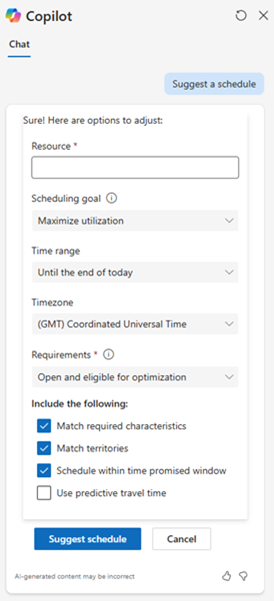
The Scheduling Operations Agent in Dynamics 365 Field Service helps dispatchers quickly and efficiently optimize a technician's schedule. It addresses common scheduling challenges by using AI to suggest intelligent updates based on real-time conditions. For example, if a technician experiences same-day cancellations, the agent can recommend nearby work orders that align with promised times and priorities. If a technician is running behind schedule, the agent can help adjust the remaining bookings to minimize delays.