Note
Access to this page requires authorization. You can try signing in or changing directories.
Access to this page requires authorization. You can try changing directories.
Note
This article reflects the new experiences for creating agents and workflows in Microsoft Copilot Studio. The new agent experience is currently available as a production-ready preview. Learn about the two agent experiences in Classic vs. new agent experience. The new workflows experience is in public preview. Learn about the two workflows experiences in Workflows overview.
- Public preview features aren't meant for production use and might have restricted functionality.
- Production-ready and public previews are subject to supplemental terms of use.
- Some capabilities available in the classic experience aren't yet available in the new experience.
- Agents and workflows created in the new experience can't be converted to the classic experience.
Workflows are created and edited in the redesigned visual designer in Copilot Studio. The designer provides a canvas where you can build or edit an automation, add and remove actions, check for errors, and publish your workflow without leaving the designer.
Important
This article contains Microsoft Copilot Studio preview documentation and is subject to change.
Preview features aren't meant for production use and may have restricted functionality. These features are available before an official release so that you can get early access and provide feedback.
If you're building a production-ready agent, see Microsoft Copilot Studio Overview.
Display a workflow in the designer
To display a workflow in the designer, open Copilot Studio, select Workflows, select the workflow, and then select the Build tab.

Change how your workflow is displayed
Depending on the size and complexity of your workflow, you might want to adjust how it's displayed to make it easier to work with. The toolbar at the bottom-left corner of the canvas controls the view.

Legend:
- Zoom in: Increase the size of the workflow on the canvas.
- Zoom out: Decrease the size of the workflow on the canvas.
- Fit view: Resize the view to fit the entire workflow on the canvas.
- Tidy up: Reorganize the workflow and branches for a cleaner end-to-end view.
- Vertical layout: Switch to a vertical layout view of the workflow.
Add and remove actions
On the card after which you want to add the action, select Add a step. The Add pane opens.
Under Add, start typing the action you want your workflow to perform or the connector you want to add, and then select it from the list. Depending on your selection, you might need to provide additional information to complete the action.
If you determine that an action isn't needed, select the Delete icon on the upper-right corner of the action.
Check workflow parameters
To view the parameters for a trigger or action in your workflow, select its card. The configuration panel opens on the right side. To enter a value for a parameter, select an option in the dropdown list or enter an expression to set the value dynamically.
Check for errors
Errors in workflow actions are indicated in red. To view details of an error in one action, select the error. To list all errors in the entire workflow, open the health center banner. To view the details of individual errors, select the error.
Important
You can't publish a workflow if it contains errors. You must correct all the errors before you can publish it.
Publish your workflow
If your workflow has no errors, you can publish it. On the menu at the top of the canvas, select Publish.
Test your workflow
Test runs let you verify a step or an entire workflow without leaving the designer, using either real upstream data, values you mock yourself, or outputs from a previous run.
There are two ways to run a test:
| What you want to verify | How to test | Where to find it |
|---|---|---|
| A single action or AI step in isolation | Test this node | The Test tab inside the node's side panel |
| The full workflow, end-to-end | Run flow test | The Play button in the top command bar |
Both surfaces share the same idea: provide inputs (real or mock), run, then inspect the output.
Test a single node in a workflow
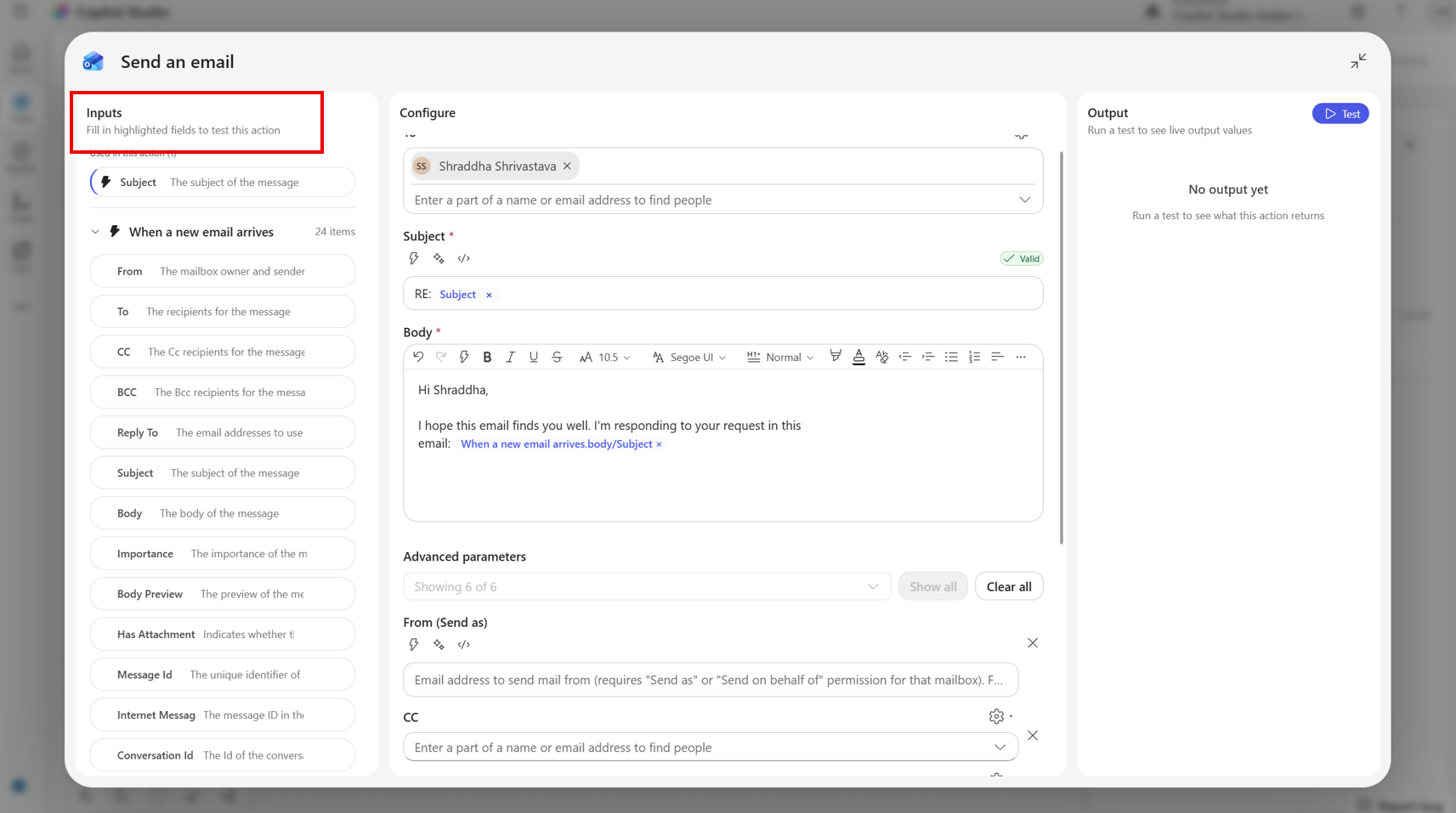
Open any action or node in your workflow and select the play or Test button. There are three sections:
Run / Reset test: Runs the step on demand, or clears the current inputs and output.

Load values from previous run: A dropdown of recent runs of this workflow. Picking one pulls the upstream step outputs from that run into the input fields below.
Inputs: One editable field per upstream step output the node references. The badge on the right of each row shows the field's expected type (string, email, date-time, number, and so on).
Output: The live result of the most recent test, formatted for the node type.
Mock inputs
By default the input fields are blank. You can:
- Type any value directly into a field. The field accepts the type shown on the right-hand badge.
- Leave a field empty if your step doesn't depend on it.
Tip
The Test tab automatically lists the upstream step outputs that this node's expressions reference. If you add a new token to the node, the corresponding field appears the next time you open Test.
Load values from a previous run
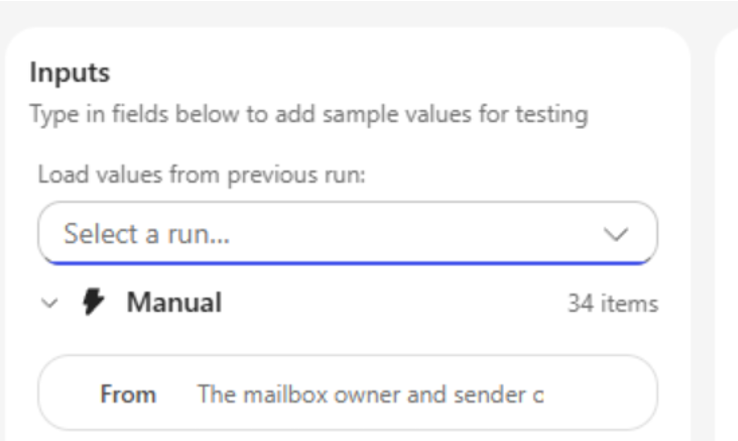
If your workflow ran before, you can replay real data instead of typing it in:
In the Load values from previous run dropdown, pick a run.
The designer fetches that run's step outputs and projects them through your node's input schema. Matching values are written into the input fields.
Edit any field afterwards if you want to tweak the scenario.
The dropdown shows the 10 most recent runs of any status. If a run doesn't include outputs for one of your upstream steps because that step was skipped or the path wasn't taken, only the available fields are filled. The rest stay as they were.
If the workflow didn't run before, No previous runs available is displayed and the dropdown is hidden.
Run the test
Select Run test. The button shows a busy state while the call is in flight; the Output section shows a spinner, then the result or an error.
- Reset test clears both the inputs and the last output.
- The test runs the node in isolation against the connector's API. The test doesn't trigger the rest of the workflow.
Test the whole workflow
In the top command bar, select the play button (Test). Test runs your workflow end-to-end against the live runtime.
Before the run starts, the designer:
- Saves and publishes the workflow if you have unsaved changes, or if it's the first time.
- Installs any new connections on first run.
- Triggers the run. The path depends on your trigger type.
| Trigger type | What happens when you select Test |
|---|---|
| Manual / HTTP request | A dialog opens for you to enter the trigger inputs, then the workflow runs immediately. |
| Recurrence/sliding window/polling | Either the schedule starts and the first run kicks off automatically, or, if already installed, the workflow runs once. |
| Connector event (for example, When an email arrives) | The workflow is published and waits. You can see Waiting for trigger.... Perform the action in the source system to fire the run. |
| HTTP webhook | The workflow is published; trigger it from the external system as you normally would. |
Mock inputs (manual trigger)
For manual triggers, the Enter manual trigger inputs dialog renders one field per input you defined on the trigger:
- Text/number/email/date: Appropriate input control.
- Boolean: Toggle switch.
- Single-choice (enum): Dropdown.
- Multi-select: Multi-select dropdown.
- File: File picker. The contents are uploaded as part of the run.
- Object/array: Multi-line text area where you can paste JSON.
Select Run to start the workflow with those inputs, or Cancel to dismiss without running. Required fields are marked with an asterisk. If values are missing or invalid, inline validation messages appear and the run is blocked until they're fixed.
The dialog appears every time you select Test. Values aren't saved between runs, so you can quickly try different scenarios.
Watch the run
Once a run is in flight:
- The command bar shows a Cancel button while the run is active.
- The Activity panel on the right lists the current run at the top with a status badge: Running, Waiting, Succeeded, Failed, or Canceled. Select any run to open it on the canvas and inspect each step's inputs and outputs.
Select past runs
The Activity panel doubles as your workflow's run history:
- Filter by All/Succeeded/Failed/Running using the dropdown at the top.
- Select Refresh to refetch the list.
- Select Load More at the bottom to page back further.
- Selecting a run loads it onto the canvas, where each node shows the inputs it received and the outputs it produced for that run. The data is the same as what the node-level Test tab uses when you choose a run from its dropdown.
When to use each type of test
- Iterating on a single AI step or connector action? Use Test this node. It's faster, doesn't publish, and lets you mock just the upstream values that matter.
- Validating end-to-end behavior or trigger logic? Use Run flow test. It exercises the whole graph against the real runtime.
- Reproducing a production issue? Open the failing run from the Activity panel, then open the failing node and use Load values from previous run in its Test tab to replay the exact upstream data into the action.